This is a shareable, personal learning and research tool as part of the ABS RG The Modern Intellectual Traditions. Contents on this page are a personal initiative and are not an official part of the ABS course content. This is not a complete list of readings, resources, etc.
In a humble posture of learning we are helping each other correlate some of the insights we are exploring with the teachings of the Faith.
-
Descartes at the dawn of the Modern Age See Cahoone (2010:7-16) "Philosophy and the Modern Age".
-
Scholasticism and the Scientific Revolution See Cahoone (2010:17-29) "Scholasticism and the Scientific Revolution". url
-
The Rationalism and Dualism of Descartes
Week 2 (January 31): Scholasticism and the Scientific Revolution Lecture 2: https://www.youtube.com/watch?v=9t36Jkz6q6I&t=804s
Supplementary Material: Warburton, Chapter 2.
Key questions for Week 2
-
What is Aristotle’s concept of primary substance? Is there anything that the Writings identify as primary substance in the sense that Aristotle means it?
- "
"Substance "hypokeimenon" contains parts but is not a part of anything; and properties are predicated of it, but it is not predicated of anything." (Cahoone 2010:21)
The Wikipedia article substance theory, or substance–attribute theory, refers to this as an ontological theory "that objects are constituted each by a substance and properties borne by the substance but distinct from it. In this role, a substance can be referred to as a substratum or a thing-in-itself. Substances are particulars that are ontologically independent: they are able to exist all by themselves.
-
"Substance is that which cannot be predicated of anything or be said to be in anything". Primary substances are particulars—this particular man, this particular horse, etc. He distinguishes primary substances, such as an individual man—Socrates—from secondary substances. Secondary substances contain the first. Secondary substances are "universals and can be predicated". He uses the example of Socrates as a primary substance and man as a secondary substance. "Man is predicated of Socrates, and therefore all that is predicated of man is predicated of Socrates". An individual man exists in the genus "animal" and the species "man". Man and animal are secondary substances, as both "man" and "animal. The property "colour" > white/brown/black, for example, is in "certain" or individual bodies, but not in every body universally.
In Aristotle's ontological theory about primary and secondary substances, he uses the term ousia, which means essence or substance when he talks about genera, such as "animal", and species, such as "man". Aristotle primarily used substance in terms of category of substance. This individual/person/horse that are iterations of universals and inhere to the essential properties.
The Wikipedia article substance theory, or substance–attribute theory, refers to this as an ontological theory "that objects are constituted each by a substance and properties borne by the substance but distinct from it. In this role, a substance can be referred to as a substratum or a thing-in-itself. Substances are particulars that are ontologically independent: they are able to exist all by themselves.
From Calhoone (2010)
In Galileo's new science of mechanics explained that the motion of a body was dependent on its mass and shape, not on Aristotle's concept from c 350 BC, of the qualities or properties of a substance, such as he described in the four causes—matter, form, agent, and télos.
Aristotle's "physics" was foundational to his other works and included topics that would in the twenty first century be categorized under "philosophy of mind, sensory experience, memory, anatomy and biology" according to the Wikipedia articles on Physics (Aristotle), Aristotelian physics, and Galileo Galilei.
Aristotle described four causes or explanations of change as seen on earth: the material, formal, efficient, and final causes of things. As regards living things, Aristotle's biology relied on observation of natural kinds, both the basic kinds and the groups to which these belonged. He did not conduct experiments in the modern sense, but relied on amassing data, observational procedures such as dissection, and making hypotheses about relationships between measurable quantities such as body size and lifespan.
Notes: Aristotle, Categories trans. Ackrill (1988) aside: Aristotle never said this syllogism: "All men are mortal, Socrates is a man, therefore, Socrates is mortal", "Socrates is human. Everything human is an animal. Therefore, Socrates is an animal." Mill referred to this his A System of logic (1843).
‘Abdu’l-Bahá says, “the rational soul is the substance through which the body exists.
According to Ian Kluge, "The issue concerning Plato’s forms or Ideas is, of course, vital in this debate. The bottom line is that the Bahá’í Writings are clearly Platonic insofar as they present a variation of Plato’s forms or Ideas, called the “Names of God”5 as residing as independent substances in a separate realm called “the Kingdom of Names”6 which is itself identified with the First Mind.6 For Aristotle, the forms, essences, ideas or universals do not reside as independent substances in a separate realm but rather are found in particular things. In short, Aristotle and the Bahá’í Writings differ on the issue of where and how the original essences or forms reside, an issue on which the Writings take a decidedly Platonic turn." (Kluge 2003:21)
‘Abdu’l-Bahá says, “the rational soul is the substance through which the body exists.
- According to Ian Kluge, "The issue concerning Plato’s forms or Ideas is, of course, vital in this debate. The bottom line is that the Bahá’í Writings are clearly Platonic insofar as they present a variation of Plato’s forms or Ideas, called the “Names of God”5 as residing as independent substances in a separate realm called “the Kingdom of Names”6 which is itself identified with the First Mind.6 For Aristotle, the forms, essences, ideas or universals do not reside as independent substances in a separate realm but rather are found in particular things. In short, Aristotle and the Bahá’í Writings differ on the issue of where and how the original essences or forms reside, an issue on which the Writings take a decidedly Platonic turn." (Kluge 2003:21)
-
There is a brief reference in the lecture to Plato’s Forms. If you would like, you may be interested in reading Warburton’s Chapter 2 on Plato (attached). He provides a helpful description of the Forms on page 12.
- "Plato believed that the ultimate nature of all things are ideal forms that are not physical at all, kind of like mathematical shapes or mathematical objects" (Cahoone 2010:22)
-
- "This parable of the prisoners in the cave occurs halfway through Plato’s masterpiece, The Republic. It provides a memorable image of his theory of Forms, his account of the nature of reality. According to him the majority of humankind are, like the prisoners, content with a world of mere appearance. Only philosophers make the journey out of the cave and learn to experience things as they really are; only they can have genuine knowledge. The world of everyday perception is constantly changing and imperfect. But the world of the Forms to which philosophers have access is unchanging and perfect. It can’t be perceived with the five senses: it is only by means of thought that anyone can experience the Forms." (Warbuton Chapter 1 Plato) Aristotle rejected the idea of Ideal forms.
- "For the first twelve centuries of the Christian era, the [Plato’s Timaeus] formed the basis of most cosmology in the West. Indeed from the fifth century ad onwards, partial Latin translations of it provided the only generally available systematic account of nature until the scientific works of Aristotle, among others, were translated into Latin in the twelfth century. Some of the dialogue's popularity was due to the fact that the God of the Timaeus could, at a pinch, be interpreted as the God of Genesis. Reading Plato without biblical blinkers, we can see that this required plenty of imaginative interpretation; but the Christians were happy to provide it. The main differences between Plato's God and the biblical one are these: his God is not the most important thing in the universe (the Forms are, and God must take his cues from them); he is not the only God but has many assistants; he is not omnipotent but must co-operate with various natural forces; he did not create the universe from scratch but used materials that were already to hand; he has no particular interest in people - in fact he gave the job of making them to his juniors in order to keep them at arm's length." (Gottlieb The Dream of Reason. 2000:204) See Plato’s Timaeus SEP
- "Aristotle was a practical man. Though taught by Plato, he rejected his teacher’s idea that reality lay beyond the everyday world in the realm of the Forms. He did not believe in Plato’s myth of the Cave." (Warburton 2014:19)
-
"One thing which led Plato to the mysterious Forms was his fascination with mathematics, again a Pythagorean matter and again a point of difference between him and Socrates. Above its gates, Plato's Academy was said to have had the words 'No one ignorant of geometry admitted here'; Aristotle later complained that for Plato's followers, 'mathematics has come to be the whole of philosophy'—a petulant exaggeration, but a pointed one. What struck Plato about the objects dealt with in mathematics, such as numbers and triangles, is that they are ideal, eternal, unchanging and pleasingly independent of earthly, visible things. Plainly one cannot see or touch the number four: it therefore exists in a different sort of realm, according to Plato. And the lines, triangles and other sorts of objects that figure in mathematical proofs cannot be identified with anything physical either. Particular physical lines and triangles are nothing more than approximations to ideal mathematical ones. A perfect line, for example, would have no thickness; but any visible line, or rim of a physical object, always will. Given the impressiveness of mathematics, Plato reasoned, other sorts of knowledge ought to copy it and be about ideal and incorporeal objects too. These objects of knowledge were the Forms."(Gottlieb The Dream of Reason. 2000:147)
"Aristotle frequently attacked Socrates along these lines: 'We must not limit our inquiry to knowing what it [virtue] is, but extend it to how it is to be produced.'(Gottlieb The Dream of Reason. 2000:152)
"The Academy accordingly offered instruction in all areas of learning, from geography, botanical classification and political history to the most abstract philosophical doctrines about the Forms, much of the latter no doubt given by Plato himself. It became a renowned centre of research in mathematics and astronomy in particular. Two of the most important mathematicians before Euclid, namely Heraclides Pontius and Eudoxus of Cnidus, were associated with the Academy. And it was there that Aristotle, who started attending at the age of about seventeen, developed his very productive interest in biology."(Gottlieb The Dream of Reason. 2000:178)
-
"In Phaedo Plato presents a variety of arguments for the immortality of the soul, but the one that is relevant for our purposes is that the intellect is immaterial because Forms are immaterial and intellect must have an affinity with the Forms it apprehends (78b4–84b8)." Dualism. SAP
-
A key contribution of Aristotle’s is his concept of the four causes. The philosophical tradition inspired by the work of Aristotle—Aristotelianism—four causes or four explanations that answer the question, Why?
- The four causes are: matter/material , form/formal (structure), agent/the efficient, and the télos: teleology end/purpose/final cause. He said that we cannot know a thing without knowing its cause.
- Aristotle gave special place in the four causes to teleology, télos: teleology end/purpose/final cause, a concept that originated with Plato and Aristotle. They both believed that both human and nonhumans in nature had a final cause. SEP described them as the founding fathers of virtue ethics in the West.
- He answers "why-questions by a scheme of four causes, including purpose or teleology, and emphasizes virtue ethics." (Cahoone 2010) provides the example of a ship to explain it.
-
Can you think of your own example? In what ways is understanding causality in this way helpful?
-
How is primary substance distinguished from the concept of properties and predicates?
- A primary substance can have properties, such as colour, but a property cannot have primary substance. A primary substance can predicate.
- "Substance contains parts but is not a part of anything; and properties are predicated of it, but it is not predicated of anything." (Cahoone 2010:21)
-
A key point is the concept of things having a final cause, or purpose, or telos. Can you think of ways in which this concept is helpful and not helpful?
- Aristotle gave special place in the four causes to teleology, télos: teleology end/purpose/final cause, a concept that originated with Plato and Aristotle. They both believed that both human and nonhumans in nature had a final cause. SEP described them as the founding fathers of virtue ethics in the West.
-
How does Artistotle’s concepts of the psyche, or soul, of the vegetable, animal, and human kingdoms relate to ‘Abdu’l‑Bahá’s approach in Some Answered Questions (see some of His talks in the linked document above)?
-
In The Nicomachean Ethics, Aristotle asks, "How should we live?"(Warbuton Aristotle 2014:19) Aristotle said that to understand the real nature of eudaimonia—happiness—we need to understand what is the purpose/work the "characteristic function or activity (an ergon) of man".(Warbuton Aristotle 2014:22) The good and excellence of a flute-player, statuary, or artisan "is thought to reside in their work, so it would seem to be with man, if there is any work belonging to him". Does "man" as the universal or secondary substance, have no work, purpose, or source of action? "Man as Man has none, but is left by Nature without a work?" Or "would not one rather hold, that as eye, hand, and foot, and generally each of his members, has manifestly some special work; so too the whole Man, as distinct from all these, has some work of his own?" (The Nicomachean Ethics) [18] What is peculiar to man? Vegetables also share mere life with man. Man also has the senses and sensation, of nourishment and growth like the animals. Aristotle says that man is unique because he had a "kind of life of the Rational Nature apt to act." One part of this rational nature is obedient to reason. He then says that the "work of Man is a working of the soul in accordance with reason." For a man to be good and noble involves the working of the rational soul in the way of Excellence.(The Nicomachean Ethics) "The ergon of human beings is rational activity."(Warbuton Aristotle 2014:22) "Excellence at being human involves virtuous action" and this leads to eudaimonia—happiness.(Warbuton Aristotle 2014:22)
- Like Aristotle, ʻAbdu'l-Bahá considering reality, saw "organic beings" not "objects and mechanical artifacts".(Saiedi 14 Sep 2020) In his 1921 ʻAbdu'l-Bahá's Tablet To Dr. Forel, ʻAbdu'l-Bahá defined the realm of nature as “the necessary relations inherent in the realities of things.” That statement, written in 1921, two months before ʻAbdu'l-Bahá’s passing, employs the same terms used throughout his various writings to define religion, science, and love as well. But when ʻAbdu'l-Bahá considered reality, he saw them as organic beings. In the above quotation, he used the example of human body: "Consider the body of man, and let the part be an indication of the whole. Consider how these diverse parts and members of the human body are closely connected and harmoniously united one with the other. Every part is the essential requisite of all other parts and has a function by itself. It is the mind that is the all-unifying agency that so uniteth all the component parts one with the other that each dischargeth its specific function in perfect order, and thereby co-operation and reaction are made possible."
-
In "The Five Kinds of Spirit" in Some Answered Questions, ʻAbdu'l-Bahá described the first two kinds of spirits of the vegetable and the animal, which are also composed of elements but which disappear then the elements are That is, the body of man, which is composed of the elements, is the most perfect form of composition and combination, the soundest arrangement, the noblest composition, and the most perfect of all existing things. It grows and develops through the animal spirit. (ʻAbdu'l-Bahá "The Five Kinds of Spirit". Some Answered Questions)
-
Aristotle, who had a passion for biology, tended to see the world as organic with the part existing in "terms of the whole, and the whole as resembling something alive: even the behaviour of inanimate objects was explained almost as if it were the activity of living creatures. For example, although Aristotle did not think that a falling stone literally 'wanted' to reach the earth as it plummeted towards it, he described this motion as a return to the stone's 'natural place' or home". During the Scientific Revolution, rigidly mechanistic models replaced the organic model and ways of explaining phenomenon. Boyle, Galileo and the Greek atomists described the world as a 'great automaton', and compared it to a watch or clock." (Gottlieb The Dream of Reason. 2000:426)
-
In the compilation by Elizabeth Fraser Chamberlain, ʻAbdu'l-Bahá on Divine Philosophy", ʻAbdu'l-Bahá said that "This universe is not created through the fortuitous concurrences of atoms; it is created by a great law which decrees that the tree bring forth certain definite fruit. Verily, this universe contains many worlds of which we know nothing." (ʻAbdu'l-Bahá Divine Philosophy)
-
-
What are the characteristics of Scholasticism? How does the Scholastic model coincide with, and depart from, a Baha’i perspective of the universe?
- "St. Thomas Aquinas (1224- 1274), one of the great Scholastics sought to Christianize Aristotle." (Gottlieb The Dream of Reason. 2000:427)
- According to Wikipedia, Scolasticism was a medieval school of philosophy that employed a critical organic method of philosophical analysis predicated upon the Aristotelian 10 Categories, which is a text "from Aristotle's Organon that enumerates all the possible kinds of things that can be the subject or the predicate of a proposition", the ten ontological categories, according to the Wikipedia article Categories (Aristotle),
- According to The Cambridge companion to Aristotle, The Ten Categories—Substance (οὐσία, ousia, essence or substance); Quantity (ποσόν, poson, how much); Qualification or quality (ποιόν, poion, of what kind or quality); Relative (πρός τι, pros ti, toward something); Where or place (ποῦ, pou, where); When or time (πότε, pote, when); Relative position, posture, attitude (κεῖσθαι, keisthai, to lie); Having or state, condition (ἔχειν, echein, to have or be); Doing or action (ποιεῖν, poiein, to make or do); Being affected or affection (πάσχειν, paschein, to suffer or undergo).—are "perhaps the single most heavily discussed of all Aristotelian notions".
- "Scholasticism, which means the of the "philosophy of the schools, combined Aristotle’s logic and metaphysics with Christianity that "dominated the universities of central and western Europe from the 14th through the 18th century."(Cahoone 2010:) It lasted from the 13th century until the 15th and 16th centuries with the voyages to the Americas, the "Protestant Reformation, and the rise of royal power and the middle class", and the Scientific Revolution. According to Wikipedia, Scolasticism was a medieval school of philosophy that employed a critical organic method of philosophical analysis predicated upon the Aristotelian 10 Categories. Christian scholasticism emerged within the monastic schools that translated scholastic Judeo-Islamic philosophies, and thereby "rediscovered" the collected works of Aristotle." Saadia Gaon, David ben Merwan al-Mukkamas, Maimonides, and Thomas Aquinas, were influenced by the Mutazilite work, particularly Avicennism and Averroism, and the Renaissance and the use of empirical methods were inspired at least in part by Arabic translations of Greek, Jewish, Persian and Egyptian works translated into Latin during the Renaissance of the 12th century, and taken during the Reconquista in 1492. According to the Routledge Encyclopedia of Philosophy:
"For the Islamic philosophers, logic included not only the study of formal patterns of inference and their validity but also elements of the philosophy of language and even of epistemology and metaphysics. ..In the area of formal logical analysis, they elaborated upon the theory of terms, propositions and syllogisms as formulated in Aristotle's Categories, De interpretatione and Prior Analytics. In the spirit of Aristotle, they believed that all rational argument can be reduced to a syllogism, and they regarded syllogistic theory as the focal point of logic. Even poetics was considered as a syllogistic art in some fashion by most of the major Islamic Aristotelians."
-
The remainder of the lecture focuses on the developments that led to, and the characteristics of, the Scientific Revolution. What are the main developments that led to the Scientific Revolution?
- Why were old Aristotelian physics and Ptolemaic astronomy replaced?
- Johannes Gutenberg printing press in 1439 making both the Reformation and the Scientific Revolution possible, according to Woolton. (Wooton 2017)
- The voyages of discovery 1492
- The invention of the telescope and the barometer
- Not the Reformation
- Copernicus On the Revolutions
- Vesalius 1543 treatise On the Fabric of the Human Body.
- Brahe supernova of 1572 and the comet of 1577
- Galileo phases of Venus and discovered the law of free fall
- Kepler's new astronomy
- Newtonian synthesis
- "What happened in the scientific revolution was that science developed its own procedures and modes of enquiry and thus established its independence from both philosophers and theologians." Wooton wrote that both the Reformation and the scientific revolution were possible because of Johannes Gutenberg developing the printing press in 1439. "Where previous reform movements, in both science and religion, had failed dismally, the press made it possible for these two to succeed."(Wooton 2017)
-
Galileo eliminated the concepts of final cause and substantial forms. Can you think of ways in which this development was an essential condition for science to evolve? Can you also think of ways in which this development was invariably problematic?
Galileo Galilei (1564–1642) replaced Aristotelian's natural philosophy analytical concepts, such as his categories, with a "set of mechanical archetypes that were accepted by most everyone who afterwards developed the “new sciences,” and which, in some form or another, became the hallmark of the new philosophy. His way of thinking became the way of the Scientific Revolution." He was considered to be "first "real" experimental scientist, who dropped stones from towers and ships' masts, and played with magnets, clocks, and pendulums". ("Galileo Galilei" (2005-2021).
Galileo’s replaced Aristotelian physical categories, including fire, air, water, and earth—the four four terrestrial elements, and ether—the fifth, and only, celestial element. He also replaced the motive natures of these elements. For Galileo there was only corporeal matter. He described the properties and motions of corporal matter with mathematics of proportional relations. This was the dawn of the mechanical tradition that continues to inform modern science in the 21st century. ("Galileo Galilei" (2005-2021).
-
Towards the end of the lecture, Cahoone (2010) states that scientists “were saying that the only way to understand these objects in this world is to turn away from your experience of them, from how they look day to day, and instead pay attention to an ideal mathematical reconstruction of those objects.” What are the implications of this approach for how we read reality?
- Edwin Arthur Burtt said in Metaphysical Foundations of Modern Physical Science that the mechanical universe with its Cartesian underpinning, that is, the duality of subject and object, and the mathematization of nature, culminating in “laws of nature,” is just “the objectification of the mood of an age, fitful and temporary”. These "scientific claims to truth come at the expense of other means of human knowing."
-
"This universe is not created through the fortuitous concurrences of atoms; it is created by a great law which decrees that the tree bring forth certain definite fruit. Verily, this universe contains many worlds of which we know nothing." (ʻAbdu'l-Bahá Divine Philosophy)
"Is the materialistic philosophy of this Europe, so much praised by contemporary agnostics and atheists, a philosophy to be admired? Are these people wooers of the spirit? Nay, they have drowned that capacity and are out of touch with the kingdom of reality. Is this an enviable goal to which humanity may aspire? Is this a system of philosophy through which people may become glorified? No, by God, the philosophy of glory needs no scholastic curriculum. Strive so that these people may be released from their nature worship and become like sons of wisdom from the city of light." (ʻAbdu'l-Bahá Divine Philosophy)
- "The scientific revolution was attacking Aristotelianism, which by now was woven together so tightly with Christianity that any attack on Aristotle came to be viewed as an attack on the whole of Scholasticism, including religion. The philosophical problem this posed was how to combine the new science with conceptions of the human mind, ethics, and life’s meaning, all of which were informed by Christianity."(Cahoone 2010:18-19)
- "Aristotle didn’t think that mathematics was much use in terms of understanding the nature of things" —the new science
is exclusively mathematical. It describes just a few quantitative properties of a few objects and tries to find rules like mass, velocity, and momentum that relate them to each other."
-
What are the implications of this new scientific, specifically, Isaac Newton’s) approach for religion, the soul, and freedom?
- Newton, Isaac Newton's 1687 publication, Principia: Philosophiæ Naturalis Principia Mathematica on the "mathematical principles of natural philosophy", was one step along the way where "mathematicians seized power and prestige from the philosophers".(Wooton 2017) Aristotelianism, which held that Aristotle had already written everything "worth knowing about nature", so instead of studying nature itself, the focus was on studying Aristotle's writings. When Galileo and others began to study the book of nature, this was a radical shift away from centuries of Aristotelianism.(Wooton 2017)
- "Certainly, Aristotelian philosophy was embedded in Catholic theology. The Catholic doctrine of transubstantiation — that in the Mass, bread and wine become the body and blood of Christ — was propounded through Aristotelian ideas about essence and appearance...Both Catholic and Protestant theologians knew that Aristotle had denied the immortality of the soul and the creation of the Universe, and were accustomed to making a sharp intellectual distinction between his philosophy and Christian theology. Even in the Netherlands, the Cartesians were able to establish themselves in universities only by insisting that they, too, were entitled to keep their philosophy distinct from their theology."(Wooton 2017)
- Cartesian underpinning, that is, the duality of subject and object: "The more modern versions of [mind-body] dualism have their origin in Descartes’ Meditations, and in the debate that was consequent upon Descartes’ theory. Descartes was a substance dualist.. Descartes’ conception of the relation between mind and body was quite different from that held in the Aristotelian tradition...Descartes was not an atomist, he was, like the others, a mechanist about the properties of matter...Bodies are machines that work according to their own laws. Except where there are minds interfering with it, matter proceeds deterministically, in its own right. Where there are minds requiring to influence bodies, they must work by ‘pulling levers’ in a piece of machinery that already has its own laws of operation. This raises the question of where those ‘levers’ are in the body. Descartes opted for the pineal gland, mainly because it is not duplicated on both sides of the brain, so it is a candidate for having a unique, unifying function.". Dualism. SAP According to Descartes in Meditations, It is possible for God to create anything I can clearly and distinctly perceive. If God creates something to be independent of another, they are distinct from each other. I clearly and distinctly understand my existence as a thinking thing (which does not require the existence of a body). So God can create a thinking thing independently of a body. I clearly and distinctly understand my body as an extended thing (which does not require a mind). So God can create a body independently of a mind. So my mind is a reality distinct from my body. So I (a thinking thing) can exist without a body." (Descartes 1641)
My notes
In his 1610 pamphlet on astronomy—Sidereus Nuncius (en:Starry Messengers)—Galileo, who was at that time Chief Mathematician and Philosopher to the Medici at the University of Pisa and mathematician at the University of Padua, known for his creation of powerful telescopes, was able to explain and validate Nicolaus Copernicus' heliocentrism introduced in 1543. This replaced Ptolemy's first century AD's geocentric model, which, in turn, had incorporated Aristotle's 4th century BC's lectures on nature as compiled in Physics.
Ptolemy's 1543 model was a visual representation of the way Aristotle's physics described the structure of the cosmos with the earth at the centre of concentric spheres and celestial bodies rotating around it. Aristotle said that earth, air, fire, and water—the four elements of the terrestrial realm—could change and decay. The heavenly or celestial bodies were composed of what the ancient philosophers and Scholastics—based on Aristotle—called "quintessence" or "aether"—a fifth element.
Previously, the belief was that these heavenly bodies were both perfect and unchanging. The fifth element—"quintessence" or "aether" of which they were composed, was unchangeable.
Galileo's pure mathematics and observed celestial phenomena challenged the way in which Scholastics and the Catholic Church had incorporated elements of the Copernican heliocentric system. As long as heliocentric system was merely a hypothetical theory based solely on mathematics, it was not a threat to the way the Holy Scriptures represented the cosmos.
Galileo's factual representation suggesting that the heavens were not "godly" but "chaotic" challenged the Holy Scriptures. In 1633, the Catholic Church placed him under house arrest for life. Galileo challenged the "notion of an ordered cosmos of "fixed stars" " and opened the way in which the cosmos came to be seen as a "universe infinite in both time and space—with significant and far-reaching consequences for human thought."
Aristotle's described all animate and inanimate objects in the earthly sphere as subject to change, natural motions, and decay—in contrast to those heavenly bodies composed of the fifth element, aether or quintessence. Aristotle said the motion of objects in the earthly realm was dependent on the weight and density of the matter that composed the object. He said that for that reason both earth and water tended to fall and fire and air tended to rise. Aristotle described four causes or explanations of change in the terrestrial realm—matter, form, agent, and télos, the final cause.
Galileo's new science of mechanics of the early 17th century, which explained that the motion of a body was dependent on its mass and shape, contradicted Aristotle's theory of the natural motions as qualities or properties of a substance, described in the his four causes—matter, form, agent, and télos.
Aristotle's "physics" was foundational to his other works and included topics that would in the twenty first century be categorized under "philosophy of mind, sensory experience, memory, anatomy and biology" according to the Wikipedia articles on Physics (Aristotle), Aristotelian physics, and Galileo Galilei.
Aristotle described four causes or explanations of change as seen on earth: the material, formal, efficient, and final causes of things. As regards living things, Aristotle's biology relied on observation of natural kinds, both the basic kinds and the groups to which these belonged. He did not conduct experiments in the modern sense, but relied on amassing data, observational procedures such as dissection, and making hypotheses about relationships between measurable quantities such as body size and lifespan.
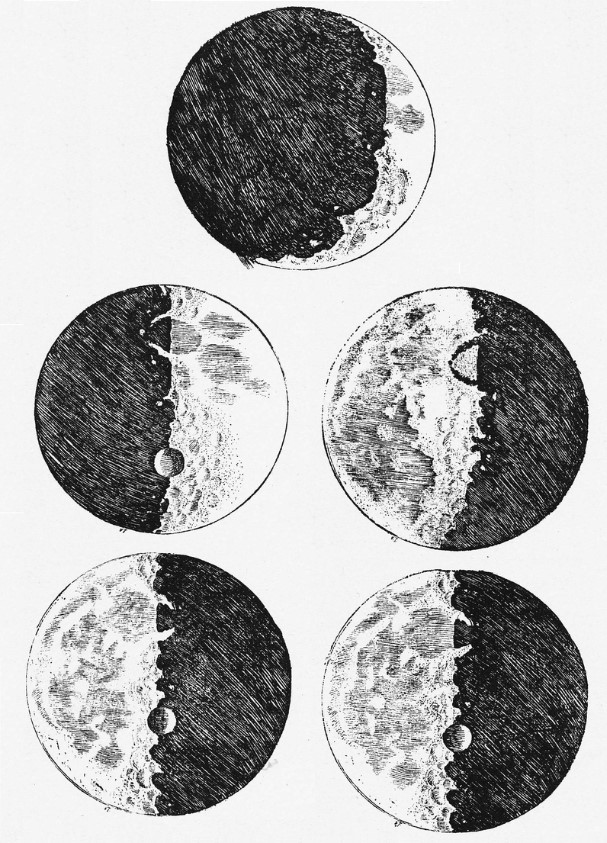 Galileo's drawings of the surface of an "imperfect moon", based on these telescopic images, contradicted the way in which Aristotle—and therefore the Scholastics—described celestial bodies. Previously, the belief was that these heavenly bodies were both perfect and unchanging. Celestial bodies were composed of what both ancient philosophers and Scholastics called "quintessence"—a fifth element after, earth, fire, sun, and water. Galileo's pure mathematics and observed celestial phenomena challenged the way in which Scholastics and the Catholic Church could incorporate elements of the Copernican heliocentric system that Scholastics and the Catholic Church because it was merely a hypothetical theory based solely on mathematics. Galileo's factual representation suggesting that the heavens were not "godly" but "chaotic" challenged the Holy Scriptures of Christianity.
The conflict ended in 1633 with Galileo being sentenced to a form of house arrest by the Catholic Church.[2]
In Galileo's new science of mechanics explained that the motion of a body was dependent on its mass and shape, not on Aristotle's concept from c 350 BC, of the qualities or properties of a substance, such as he described in the four causes—matter, form, agent, and télos.
Edwin Arthur Burtt said in Metaphysical Foundations of Modern Physical Science that the mechanical universe with its Cartesian underpinning, that is, the duality of subject and object, and the mathematization of nature, culminating in “laws of nature,” is just “the objectification of the mood of an age, fitful and temporary”. These "scientific claims to truth come at the expense of other means of human knowing."
My notes on Abdu’l-Baha's True Felicity
ʻAbdu'l-Bahá used the word sa‘ádat, which was translated into "felicity" in Some Answered Questions, which has "further connotations of prosperity, joy, and well-being." My thoughts: To what extent is Aristotle's eudaimonia—happiness—in The Nicomachean Ethics, similar to sa‘ádat or felicity. It seems to be related to Aristotle's question, "How should we live?", (Warbuton Aristotle 2014:19) where the real nature of eudaimonia is informed by the telos or final cause of man's purpose/work/ergon.(Warbuton Aristotle 2014:22)
In this Tablet, ʻAbdu'l-Bahá described how the honour/glory/exaltation/perfection in the vegetable, animal, and human worlds/realms/kingdoms is prescribed for each realm. The vegetable world attains felicity/sa‘ádat by grow, yield fruit, and finally being consumed by the bodies of animals and men. In the human world, material felicity is wholly secondary,
Chapter 15. "True Felicity" Some Answered Questions. Note that in Audible this is Chapter 17.
My notes on ‘Abdu’l-Bahá’s Tablet To Dr. Forel
This tablet was written in response to a 28 July 1921 letter from Auguste Forel. The response was written in Haifa on 21 September 1921. ʻAbdu'l-Bahá died on 28 November 1921. Translation, and therefore delivery of the letter was delayed until 2022.
In answering a question about philosophy, ʻAbdu'l-Bahá clarified that deistic philosophers It is as thou hast written, not philosophers in general but narrow-minded materialists that are meant. As to deistic philosophers, such as Socrates, Plato and Aristotle, they are indeed worthy of esteem and of the highest praise, for they have rendered distinguished services to mankind. In like manner we regard the materialistic, accomplished, moderate philosophers, who have been of service (to mankind). ʻAbdu'l-Bahá's Tablet To Dr. Forel. 1921 (1922).
In answering a question about philosophy, ʻAbdu'l-Bahá clarified that his own criticism was directed at "narrow-minded materialist" philosophers, not "deistic philosophers", like Socrates, Plato and Aristotle, and "materialistic, accomplished, moderate philosophers, who have been of service (to mankind)". They are "indeed worthy of esteem and of the highest praise, for they have rendered distinguished services to mankind."
ʻAbdu'l-Bahá described how the mind and the soul differ: "The mind is circumscribed, the soul limitless. It is by the aid of such senses as those of sight, hearing, taste, smell and touch, that the mind comprehendeth, whereas the soul is free from all agencies."
He discusses the concept of spirit in all the worlds/kingdom/realms including the mineral world. "As to the existence of spirit in the mineral: it is indubitable that minerals are endowed with a spirit and life according to the requirements of that stage. This unknown secret, too, hath become known unto the materialists who now maintain that all beings are endowed with life, even as He saith in the Qur’án, ‘All things are living’."
ʻAbdu'l-Bahá described the spirit of the vegetable world as the power of growth which is also a animating spirit of the animal and human world. The animal world also has the power or the sense of feeling. The human world has all of these powers, along with the power or reason, which does not exist in the vegetable or animal world. The animal power or sense of feeling is incapable of understanding the existence of the soul. The human mind with its power of reasoning is capable of proving that the soul exists.
Unlike the mineral, vegetable, and animal worlds, humans can fly, sail on the oceans, swim under the water, generate electricity. Man has unveiled nature's secrets through sciences, arts, crafts, inventions and discoveries, and has been able to no longer conform to the laws of nature.
"Man hath the powers of will and understanding, but nature hath them not. Nature is constrained, man is free. Nature is bereft of understanding, man understandeth. Nature is unaware of past events, but man is aware of them. Nature forecasteth not the future; man by his discerning power seeth that which is to come. Nature hath no consciousness of itself, man knoweth about all things." ʻAbdu'l-Bahá
He described two schools of philosophers. There are the materialists and the deistic. Socrates "believed in the unity of God and the existence of the soul after death."
"Man is not capable of comprehending the Divine Reality, which is absolute, has no limitations, and is not determined by anything except its Divine nature. Man can only conceive of, comprehend, or understand his own reality within his limitations, contingencies, and different stages. Man's reality is circumscribed whereas God's is all-embracing. Man can comprehend and control the natural world according to different stages in the contingent world. How can man, whose reality is "contingent conceive the Reality of the absolute?" Tablet of Wisdom Paragraph 8 -29
Note on the term ether as used in this Tablet: See this entry in Bahaipedia:
| When we study Their Writings more closely, however, we come to realise that this only seems to be the case because Their references to such topics were purposely made in such a way that they would neither offend Their addressees who believed in certain (erroneous) contemporary scientific concepts, nor make use of a terminology that had not yet been developed by contemporary scientists. |
” |
| — (Robin Mihrshahi, Australian Bahá’í Studies Journal Volume 4, p. 3-20.)[6] |
ʻAbdu'l-Bahá's Tablet To Dr. Forel. 1921 (1922).
My notes on ʻAbdu'l-Bahá 's five kinds of spirit.
The vegetable spirit results from the combination of elements and certain constituent parts, that are brought together in a composition, through God's wisdom, and from "their mutual arrangement as well as their influence upon, and their interconnection with, other created things. When these parts and elements are separated, the associated power of growth likewise ceases to exist. So, to give an analogy, electricity results from the composition of certain constituent parts, and as soon as these parts are separated, the electrical force is immediately dissipated and lost." (ʻAbdu'l-Bahá . "The Five Kinds of Spirit". )
The animal spirit also results from the combination of elements that are brought together in a single, more complete composition "when by the decree of the almighty Lord it reaches a fuller degree of combination, the animal spirit, which consists in the power of the senses, comes to exist. This power perceives sensible realities—that which can be seen, heard, tasted, smelled, or touched. After the separation and dissolution of these composed elements, this spirit will also naturally cease to exist."
"As to the human spirit, its likeness is that of a glass and the bounty of the sun. That is, the body of man, which is composed of the elements, is the most perfect form of composition and combination, the soundest arrangement, the noblest composition, and the most perfect of all existing things. It grows and develops through the animal spirit. This perfect body can be compared to a mirror, and the human spirit to the sun: If the glass is shattered or the mirror destroyed, no harm befalls the outpouring grace of the sun, which continues unabated."
"fourth degree of spirit, it is the heavenly spirit, which is the spirit of faith and the outpouring grace of the All-Merciful. This spirit proceeds from the breath of the Holy Spirit, and through a power born of God it becomes the cause of everlasting life. It is that power which makes the earthly soul heavenly and the imperfect man perfect. It cleanses the impure, unlooses the tongue of the silent, sanctifies the bondslaves of passion and desire, and confers knowledge upon the ignorant."
"The fifth degree of spirit is the Holy Spirit, which is the mediator between God and His creation. It is like a mirror facing the sun: Just as a spotless mirror receives the rays of the sun and reflects its bounty to others, so too is the Holy Spirit the mediator of the light of holiness, which it conveys from the Sun of Truth to sanctified souls. This Spirit is adorned with all the divine perfections. Whensoever it appears, the world is revived, a new cycle is ushered in, and the body of humanity is clothed in a fresh attire. It is like the spring: When it arrives, it transports the world from one condition to another....In the same way, the manifestation of Bahá’u’lláh was a new springtide which appeared with the sweet savours of holiness, with the hosts of everlasting life, and with a power born of the celestial kingdom. He established the throne of God’s sovereignty in the midmost heart of the world and, through the power of the Holy Spirit, revived the souls and ushered in a new cycle."(Abdu’l-Baha. "The Five Kinds of Spirit") My thoughts: This is similar to the description of human spirit and soul in ʻAbdu'l-Bahá's Tablet To Dr. Forel: "Now concerning mental faculties, they are in truth of the inherent properties of the soul, even as the radiation of light is the essential property of the sun. The rays of the sun are renewed but the sun itself is ever the same and unchanged. Consider how the human intellect develops and weakens, and may at times come to naught, whereas the soul changeth not. For the mind to manifest itself, the human body must be whole; and a sound mind cannot be but in a sound body, whereas the soul dependeth not upon the body."
My notes on ʻAbdu'l-Bahá 's Divine Philosophy.
"By heavenly sciences I mean divine philosophy and spiritual teachings; by the songs and fragrances of the rose garden I mean the mysteries of the kingdom of kingdoms, the secrets of the degrees of existence and the knowledge of the results of human life."
"This universe is not created through the fortuitous concurrences of atoms; it is created by a great law which decrees that the tree bring forth certain definite fruit. Verily, this universe contains many worlds of which we know nothing." (ʻAbdu'l-Bahá Divine Philosophy)
"Is the materialistic philosophy of this Europe, so much praised by contemporary agnostics and atheists, a philosophy to be admired? Are these people wooers of the spirit? Nay, they have drowned that capacity and are out of touch with the kingdom of reality. Is this an enviable goal to which humanity may aspire? Is this a system of philosophy through which people may become glorified? No, by God, the philosophy of glory needs no scholastic curriculum. Strive so that these people may be released from their nature worship and become like sons of wisdom from the city of light." (ʻAbdu'l-Bahá Divine Philosophy)
My notes on Tablets of Bahá’u’lláh revealed after the Kitáb-i-Aqdas Lawh-i-Hikmat (Tablet of Wisdom)
"After Socrates came the divine Plato who was a pupil of the former and occupied the chair of philosophy as his successor. He acknowledged his belief in God and in His signs which pervade all that hath been and shall be. Then came Aristotle, the well-known man of knowledge. He it is who discovered the power of gaseous matter. These men who stand out as leaders of the people and are preeminent among them, one and all acknowledged their belief in the immortal Being Who holdeth in His grasp the reins of all sciences." Paragraph 8
My notes on Warburton, Nigel. 25 Mar 2014:19-30; "Chapter 2: Aristotle"
"Aristotle was a practical man. Though taught by Plato, he rejected his teacher’s idea that reality lay beyond the everyday world in the realm of the Forms. He did not believe in Plato’s myth of the Cave." (Warburton 2014:19)
384 BC Aristotle born in Stagira.
Student of Plato in Athens.
Tutor to Alexander the Great.
Publishes on numerous topics including politics, tragedy and
biology.
322 BC Dies in Chalcis.
In The Nicomachean Ethics, Aristotle asks, "How should we live?"(Warbuton Aristotle 2014:19) Aristotle said that to understand the real nature of eudaimonia—happiness—we need to understand what is the purpose/work the "characteristic function or activity (an ergon) of man".(Warbuton Aristotle 2014:22)
For a man to be good and noble involves the working of the rational soul in the way of Excellence.(The Nicomachean Ethics) "The ergon of human beings is rational activity."(Warbuton Aristotle 2014:22) "Excellence at being human involves virtuous action" and this leads to eudaimonia—happiness.(Warbuton Aristotle 2014:22)
My notes on Agnes Callard on Aristotle:
"...I think that the way philosophy--one way philosophy creates progress: it doesn't itself make progress but it sort of creates it--is that there's like a mush of how people think about the world and philosophers divide it up and articulate it and create like a structure. Right? And, then that structure sort of trickles down and just becomes how people think about things, unreflectively, right? So, you could think of it as like your conceptual architecture. So, in the ancient world, people puzzled over, like, how there can be a thing, like a chair, but it can be yellow. So, really there are two things there, a chair and yellow. But, how can there be two things that are one thing? Okay. Now, for us, we're like, we can't even see the problem because like, well, it's a chair but it has a property, a property of being yellow. And, so when we say, 'It is a chair ,' and we say, 'It is yellow,' we're using the word 'is' in two different ways--the 'is' of predication and the 'is' of essence or something. Right?" (Callard 2020) "...But, all of that is Aristotle. Aristotle came up with that, right? We're just being Aristotelians but we don't notice it because Aristotle created the basic categories. In fact, we called them the 'categories' in which we think about things. So, why should you study Aristotle? Well, maybe you don't care why you think about things the way you do. But one thing is you might worry, as you worry about utilitarianism, that some of the categories that we've absorbed from philosophers, that some of our basic conceptual architecture might not be quite right." "I think you should start with Plato rather than Aristotle. I think you should start with certain dialogues rather than others. Aristotle is very hard because he's so boring to read, and there's no getting around that. And, that's really different from Plato, who is really not boring to read. And, so the nice thing about Plato is you can sort of get into it without really getting anywhere close to the bottom of it. You can sort of stay on the surface of it and get something. Is Socrates being a jerk here or does he have a point against Euthyphro? Is Euthyphro a conservative or a radical?"
My notes on Gottlieb on Aristotle
"Perhaps the prevalence of competitive public debate also helps to explain how naturalism, and thus philosophy, arose in Greece. The citizens of the Greek city-states were famously argumentative; indeed, the Greeks seem to have regarded advocacy and criticism as the noblest uses of speech. Aristotle wrote that 'the power of speech is intended to set forth the expedient and the inexpedient, and therefore likewise the just and the unjust'. It is no miracle that in at least some of the city-states, the tools of disputation should eventually have been turned on the study of nature. It is also worth noting that when the first philosophers declaimed and expostulated, it was to the ears of an increasingly literate audience. Alphabetic writing first arose in Greece in around the eighth century and was becoming widespread by the sixth?" (Gottlieb 2000:20)
"For Aristotle - and, even more so, for Plato before him - nature was full of purposeful design and could not be explained in purely mechanical terms. Plato and Aristotle won that battle." (Gottlieb The Dream of Reason. 2000:80)
"There was something else wrong with philosophers like Anaxagoras, as far as Plato and Aristotle were concerned. Scientific philosophy such as his made too little of the role of reason and purpose in nature." (Gottlieb The Dream of Reason. 2000:86)
"Later on I shall return to this idea that things ought to be explained by reference to mind or reason and to how it is 'best for them to be'. Plato and (to a lesser extent) Aristotle championed such an approach, and for 2,000 years their influence eclipsed the more materialist and mechanical type of scientific thinking that Anaxagoras and the physici before him had been developing. Materialist science was later reborn and flowered in the age of Galileo and Newton. But before temporarily sinking behind the figures of Plato and Aristotle, it reached its high point in the ancient world with the so-called 'atomists', Leucippus and Democritus, who can in some respects be seen as seventeenth-century thinkers ahead of their time."(Gottlieb The Dream of Reason. 2000:88)
"For most of the 2,400 years that separate us from Democritus, his doctrines lay submerged under the disapproving weight of Plato, Aristotle and the Christian Church. But his fortunes revived in the scientific revolution of the seventeenth century and have stayed high ever since, while the physical theories of Plato and Aristotle have been discarded."(Gottlieb The Dream of Reason. 2000:94)
"They saw a vast, unlimited and impersonal universe, quite unlike the almost homely and human one that Plato and Aristotle bequeathed to the first seventeen centuries of the Christian era. Because they had somehow to account for the emergence of order and life out of the chaos of careering atoms, the atomists proposed an infinite universe, vast enough for it to seem reasonable to suppose that every sort of world cropped up somewhere."(Gottlieb The Dream of Reason. 2000:104)
"Although [Aristotle] never heard Socrates' opinions at first hand, he studied for some twenty years in Plato's Academy and had plenty of opportunity to hear Plato's views from Plato himself. He was therefore in a position to disentangle the thinking of the two men. To a considerable extent, Aristotle's testimony lets one subtract Plato from his own dialogues and see the Socratic remainder. Aristotle was also much less in awe of Socrates than Plato was, and therefore managed to take a more dispassionate approach to his teachings."(Gottlieb The Dream of Reason. 2000:144)
"One thing which led Plato to the mysterious Forms was his fascination with mathematics, again a Pythagorean matter and again a point of difference between him and Socrates. Above its gates, Plato's Academy was said to have had the words 'No one ignorant of geometry admitted here'; Aristotle later complained that for Plato's followers, 'mathematics has come to be the whole of philosophy'—a petulant exaggeration, but a pointed one. What struck Plato about the objects dealt with in mathematics, such as numbers and triangles, is that they are ideal, eternal, unchanging and pleasingly independent of earthly, visible things. Plainly one cannot see or touch the number four: it therefore exists in a different sort of realm, according to Plato. And the lines, triangles and other sorts of objects that figure in mathematical proofs cannot be identified with anything physical either. Particular physical lines and triangles are nothing more than approximations to ideal mathematical ones. A perfect line, for example, would have no thickness; but any visible line, or rim of a physical object, always will. Given the impressiveness of mathematics, Plato reasoned, other sorts of knowledge ought to copy it and be about ideal and incorporeal objects too. These objects of knowledge were the Forms."(Gottlieb The Dream of Reason. 2000:147)
"Aristotle frequently attacked Socrates along these lines: 'We must not limit our inquiry to knowing what it [virtue] is, but extend it to how it is to be produced.'(Gottlieb The Dream of Reason. 2000:152)
"The Academy accordingly offered instruction in all areas of learning, from geography, botanical classification and political history to the most abstract philosophical doctrines about the Forms, much of the latter no doubt given by Plato himself. It became a renowned centre of research in mathematics and astronomy in par- ticular. Two of the most important mathematicians before Euclid, namely Heraclides Pontius and Eudoxus of Cnidus, were associated with the Academy. And it was there that Aristotle, who started attending at the age of about seventeen, developed his very productive interest in biology."(Gottlieb The Dream of Reason. 2000:178)
"But it shows that Plato did not make the mistake for which Aristotle and others took the real Socrates to task, namely that of ignoring the role of character in determining moral behaviour. The guardians of the Republic would be virtuous, rational and generally benign because everything in their early life was designed to mould their characters to that end."(Gottlieb The Dream of Reason. 2000:184)
"For the first twelve centuries of the Christian era, the [Plato’s Timaeus] formed the basis of most cosmology in the West. Indeed from the fifth century ad onwards, partial Latin translations of it provided the only generally available systematic account of nature until the scientific works of Aristotle, among others, were translated into Latin in the twelfth century. Some of the dialogue's popularity was due to the fact that the God of the Timaeus could, at a pinch, be interpreted as the God of Genesis. Reading Plato without biblical blinkers, we can see that this required plenty of imaginative interpretation; but the Christians were happy to provide it. The main differences between Plato's God and the biblical one are these: his God is not the most important thing in the universe (the Forms are, and God must take his cues from them); he is not the only God but has many assistants; he is not omnipotent but must co-operate with various natural forces; he did not create the universe from scratch but used materials that were already to hand; he has no particular interest in people - in fact he gave the job of making them to his juniors in order to keep them at arm's length." (Gottlieb The Dream of Reason. 2000:204) See Plato’s Timaeus SEP
"Alexandria's most remarkable philosopher of the next century, John Philoponus (ad C.490-C.530), was a Christian writer on physics and philosophy who was so ahead of his time that he tends to be left out of history in order to keep the story simple. He argued brilliantly against Aristotle's world-picture...Philoponus was the last of his kind: as far as one can tell, nobody in Western Europe practised his sort of analysis of nature again until the fourteenth century. The Greek tradition of inquiry had passed instead to the Arab world. Greek medical, scientific, mathematical and philosophical learning spread to Arab lands from around the middle of the eighth century and stayed there until Latin translations were made from the texts in Arab hands 300-400 years later. Until the end of the twelfth century, Arab civilization had a clear lead in all these fields. The West had nobody to compare with great polymaths like Al-Kindi (ad C.812-C.873), Al-Farabi (ad C.870-C.950) and Ibn Sina (later known in the west as Avicenna, ad C.980-C. 103 7), or the many specialist doctors, physicists and especially mathematicians whose works were so eagerly studied in the West when they eventually became available. Arab scholars were familiar with the writings of Hippocrates, Galen, Euclid, Ptolemy and Archimed, as well as those of Plato and Aristotle. They also did important original research, developing among many other things a sophisticated theory of optics in the eleventh century. We have already looked at some of the reasons why the spirit of inquiry declined so drastically in the West. Exactly why it flourished, for a while, in the Arab world is too large a subject to be addressed here." (Gottlieb The Dream of Reason. 2000:386-7)
"The main target of the condemnations was Averroism named after the twelfth-century Islamic Arab commentator on Aristotle. Averroes regarded philosophy as the sole provider of literal truth, and theology as a collection of largely metaphorical sayings. The Averroist approach was to examine each topic by the light of natural reason, as Aristotle had done, and then to try and work out how God could be fined into the picture. It was important not to proceed the other way round and put religion first: alleged religious revelations could not be allowed to overthrow what one had painstakingly managed to work out about the world."(Gottlieb The Dream of Reason. 2000:399)
"Aristotle's God was similarly obliged to observe the principles of physics. But the biblical God wrote the laws of nature Himself and so could create whatever He wanted."(Gottlieb The Dream of Reason. 2000:400)
"Thinkers in the fourteenth century had the ability and the inclination to tinker with Aristotle's theories, but they did not have anything comparably systematic to put in their place. Aristotle had explained more or less everything, so why upset the apple-cart?" (Gottlieb The Dream of Reason. 2000:404)
"We have already seen that the most important difference between Aristotle's approach to scientific knowledge and that of a man like Francis Bacon, the prophet of modern science, lay in their hopes for its practical application (see page 226). Aristotle had virtually no such hopes; Bacon was obsessed by them. 'Human knowledge and human power come to the same thing,' Bacon wrote, 'for where the cause is not known the effect cannot be produced.' In the 1620s he advocated the founding of a club of investigators whose goal would be 'the knowledge of Causes, and secret motions of things; and the enlarging of the bounds of Human Empire, to the effecting of all things possible'. Some forty years later, Bacon's proposal led to the establishment of the Royal Society, whose members included Robert Boyle and Isaac Newton." (Gottlieb The Dream of Reason. 2000:413)
"Aristotle and his commentators also benefited from Gutenberg's revolution; Aristotelian works were much reprinted in the early sixteenth century and may have reached a larger audience than ever before." (Gottlieb The Dream of Reason. 2000:419)
"Galileo's atomistic physics did not only have awkward theological implications. It amounted to a comprehensive rejection of traditional natural philosophy. Perhaps because of Aristotle's passion for biology, medieval science had inherited an essentially organic model of the world. Aristotle tended to see the part in terms of the whole, and the whole as resembling something alive: even the behaviour of inanimate objects was explained almost as if it were the activity of living creatures. For example, although Aristotle did not think that a falling stone literally 'wanted' to reach the earth as it plummeted towards it, he described this motion as a return to the stone's 'natural place' or home, almost as if it were a rabbit heading for its warren. Such semi-biological modes of explanation were now replaced by rigidly mechanical ones. Thus Boyle, following Galileo and the Greek atomists, described the world as a 'great automaton', and compared it to a watch or clock." (Gottlieb The Dream of Reason. 2000:426)
"Aquinas sought to Christianize Aristotle." (Gottlieb The Dream of Reason. 2000:427)
My notes on Cahoone on Aristotle
"Aristotle (384–322 B.C.E.): A student of Plato, this Athenian philosopher made seminal contributions to almost every field of knowledge. His physics lasted until the 17th century, his biology until Charles Darwin, and his logic until the late 19th century." (Cahoone 2010:19)
My notes on Cahoone on Newton
Newton, Isaac (1643–1727): "The greatest scientist of early modern Europe. His discovery that the same laws of motion guide terrestrial objects and planets was the greatest achievement of the scientific revolution."
Scholasticism: The synthesis of the philosophy of Aristotle and Christian theology that was forged in the 13th century and dominated the universities of central and western Europe from the 14th through the 18th century.
Edwin Arthur Burtt's Review: "The Metaphysical Foundations of Modern Physical Science is the first historical account of the scientific revolution.1 In this book Burtt placed Newton within a context of culture and religion without devaluing his scientific achievement. But, in a surprising way, the Newtonian world-view is thrown into new light. Burtt claims that the mechanical universe with its Cartesian underpinning, that is, the duality of subject and object, and the mathematization of nature, culminating in “laws of nature,” is just “he objectification of the mood of an age, fitful and temporary”. Furthermore, scientific claims to truth come at the expense of other means of human knowing which we can not afford to lose. Although the book might be read simply as a polemic against logical positivism, which was competing with pragmatism in the U.S. in the 1920s, it should also be considered as a demonstration of a new philosophy of science. In The Metaphysical Foundations of Modern Physical Science Burtt is saying that science is a culturally conditioned expression of human experience, just one way of knowing among many, and that scientific truth is a changing truth.
Alexandre Koyré's From the Closed World to the Infinite Universe: "During the sixteenth and seventeenth centuries a radical change occurred in the patterns and the framework of European thought. In the wake of discoveries through the telescope and Copernican theory, the notion of an ordered cosmos of "fixed stars" gave way to that of a universe infinite in both time and space—with significant and far-reaching consequences for human thought. Alexandre Koyré interprets this revolution in terms of the change that occurred in our conception of the universe and our place in it and shows the primacy of this change in the development of the modern world."
"Substance is that which cannot be predicated of anything or be said to be in anything". Primary substances are particulars—this particular man, this particular horse, etc. He distinguishes primary substances, such as an individual man—Socrates—from secondary substances. Secondary substances contain the first. Secondary substances are "universals and can be predicated". He uses the example of Socrates as a primary substance and man as a secondary substance. "Man is predicated of Socrates, and therefore all that is predicated of man is predicated of Socrates". An individual man exists in the genus "animal" and the species "man". Man and animal are secondary substances, as both "man" and "animal. The property "colour" > white/brown/black, for example, is in "certain" or individual bodies, but not in every body universally. In Aristotle's ontological theory about primary and secondary substances, he uses the term ousia, which means essence or substance when he talks about genera, such as "animal", and species, such as "man". Aristotle primarily used substance in terms of category of substance. This individual/person/horse that are iterations of universals and inhere to the essential properties. "A substance—that which is called a substance most strictly, primarily, and most of all—is that which is neither said of a subject nor in a subject, e.g. the individual man or the individual horse. The species in which the things primarily called substances are, are called secondary substances, as also are the genera of these species. For example, the individual man belongs in a species, man, and animal is a genus of the species; so these—both man and animal—are called secondary substances." Aristotle, Categories trans. Ackrill (1988) aside: Aristotle never said this syllogism: "All men are mortal, Socrates is a man, therefore, Socrates is mortal", "Socrates is human. Everything human is an animal. Therefore, Socrates is an animal." Mill referred to this his A System of logic (1843). The Wikipedia article substance theory, or substance–attribute theory, refers to this as an ontological theory "that objects are constituted each by a substance and properties borne by the substance but distinct from it. In this role, a substance can be referred to as a substratum or a thing-in-itself.[1][2] Substances are particulars that are ontologically independent: they are able to exist all by themselves.[3][4]"
My notes on scholasticism
"Scholasticism, which means the of the "philosophy of the schools, combined Aristotle’s logic and metaphysics with Christianity."(Cahoone 2010:) It lasted from the 13th century until the 15th and 16th centuries with the voyages to the Americas, the "Protestant Reformation, and the rise of royal power and the middle class", and the Scientific Revolution. According to Wikipedia, Scolasticism was a medieval school of philosophy that employed a critical organic method of philosophical analysis predicated upon the Aristotelian 10 Categories.
Citations from Ian Kluge
"Bahá’í Writings re-affirm many of the philosophical insights first developed by Aristotle...The Aristotelian substratum not only makes it is possible to resolve many apparent paradoxes in the Writings, but also to explicate the Writings in a way that harmonizes with common human experience and common sense." (Kluge 2003:18)
The "foundations of ‘Bahá’í physics’ are Aristotelian, by which I mean that there is a pervasive and systematic overlap between Aristotle’s book Physics and the Bahá’í Teachings...One of the key issues on which Aristotle and the Bahá’í Writings also agree is the eternity of the world or creation. According to Aristotle, prime matter, which is the capacity or potential to receive form, has always existed along with the Unmoved Mover since a mover without something to move or affect is logically impossible.8 In other words, Aristotle’s matter is coeternal although logically dependent on the Unmoved Mover" (Kluge 2003:21)
While Aristotle does in fact use the expressions “prime matter” (prôtê hulê) and “primary underlying thing” (prôton hupokeimenon) several times in Physics and Metaphysics, an SAP article questions Aristotle's use and development of the concept prime matter.(Form vs. Matter SAP) The article refers to Aristotle's doctrine of “hylomorphism”—matter (hulê) and form (eidos or morphê) , stating that "every physical object is a compound of matter and form. (Form vs. Matter SAP)
"The issue concerning Plato’s forms or Ideas is, of course, vital in this debate. The bottom line is that the Bahá’í Writings are clearly Platonic insofar as they present a variation of Plato’s forms or Ideas, called the “Names of God”5 as residing as independent substances in a separate realm called “the Kingdom of Names”6 which is itself identified with the First Mind.6 For Aristotle, the forms, essences, ideas or universals do not reside as independent substances in a separate realm but rather are found in particular things. In short, Aristotle and the Bahá’í Writings differ on the issue of where and how the original essences or forms reside, an issue on which the Writings take a decidedly Platonic turn." (Kluge 2003:21)
"Another far-reaching agreement between the Bahá’í Writings and Aristotle concerns the all important subject of causality."Abdu’l-Bahá:
"Essential pre-existence is an existence which is not preceded by a cause; essential origination is preceded by a cause. Temporal pre-existence has no beginning; temporal origination has both a beginning and an end. For the existence of each and every thing depends upon four causes: the efficient cause, the material cause, the formal cause, and the final cause.156 So this chair has a creator who is a carpenter, a matter which is wood, a form which is that of a chair, and a purpose which is to serve as a seat. Therefore, this chair is essentially originated, for it is preceded by, and its existence is conditioned upon, a cause. This is called essential or intrinsic origination." (Chapter 80. "Pre-existence and Origination" in Some Answered Questions.
Kluge cited this quote: "In Some Answered Questions, ‘Abdu’l-Bahá states that all phenomena require four causes the existence of everything depends upon four causes—the efficient cause, the matter, the form and the final cause. For example, this chair has a maker who is a carpenter, a substance which is wood, a form which is that of a chair, and a purpose which is that it is to be used as a seat. Therefore, this chair is essentially phenomenal, for it is preceded by a cause, and its existence depends upon causes. This is called “the essential and really phenomenal." (Kluge 2003:27)
3.3) "Soul as Substance: Among other agreements between Aristotle and the Writings, we find the idea that the soul is a substance,154 not, of course, in the sense of Locke’s materialist misunderstanding of the term, but in the sense of a distinct entity that does not merely exist as a predicate of something else. Indeed, it is “the cause or source of the living body.”155 The soul is real and no mere emergent or epiphenomenon of physiological processes and is distinct from the body. In other words, when discussing the soul, we must not confuse the appearance of the soul in the body once the body is an adequate mirror and the notion that soul is a product of physiological events. In fact, the situation is quite the other way around: as ‘Abdu’l-Bahá says, “the rational soul is the substance through which the body exists.”156 Elsewhere, He states:35 Lights of ‘Irfán Book Four "Some think that the body is the substance and exists by itself, and that the spirit is accidental and depends upon the substance of the body, although, on the contrary, the rational soul is the substance, and the body depends upon it. If the accident—that is to say, the body—be destroyed, the substance, the spirit, remains."15 (Kluge 2003:35)
46. Evolution and the True Nature of Man, 47. The Origin of the Universe and the Evolution of Man, 48. The Difference between Man and Animal 49. Evolution and the Existence of Man 50. Spiritual Proofs of the Originality of Man 51. The Appearance of the Spirit and the Mind in Man
66. The Subsistence of the Rational Soul after the Death of the Body "The rational soul—the human spirit—did not descend into this body or subsist through it to begin with, that it should require some substance to depend upon after the constituent parts of the body have decomposed. On the contrary, the rational soul is the substance upon which the body depends. The rational soul is endowed from the beginning with individuality; it does not acquire it through the intermediary of the body....These statements could almost be a paraphrase of Aristotle’s claim that “the soul is the primary substance and the body is the matter”158 which is the philosophical gist of what ‘Abdu’lBahá says. ...These views harmonize with Aristotle’s who tells us, for example, that the soul is a substance, form, essence and actuality, 162 the body’s final cause 163 as well as the origin or cause of the living body.164 Indeed, ‘Abdu’l-Bahá’s statement here also tells us that the soul or spirit is, in effect, unassailable by external events, a view that is shared by Aristotle when he writes that “The incapacity of old age is due to the affection not of the soul but of its vehicle . . . mind itself is impassible . . .” 165
‘Abdu’l-Bahá “The Subsistence of the Rational Soul after the Death of the Body” Some Answered Questions.
QUESTION: AFTER THE body has been cast off and the spirit has taken flight, through what will the rational soul subsist? Let us suppose that those souls who are aided by the outpourings of the Holy Spirit attain true existence and everlasting life. But what becomes of those rational souls who are veiled from God?
Answer: Some hold that the body is the substance and that it subsists by itself, and that the spirit is an accident which subsists through the substance of the body. The truth, however, is that the rational soul is the substance through which the body subsists. If the accident—the body—is destroyed, the substance—the spirit—remains.
“Secondly, the rational soul, or the human spirit, does not subsist through this body by inherence—that is to say, it does not enter it; for inherence and entrance are characteristics of bodies, and the rational soul is sanctified above this. It never entered this body to begin with, that it should require, upon leaving it, some other abode. No, the connection of the spirit with the body is even as the connection of this lamp with a mirror. If the mirror is polished and perfected, the light of the lamp appears therein, and if the mirror is broken or covered with dust, the light remains concealed.”
“The rational soul—the human spirit—did not descend into this body or subsist through it to begin with, that it should require some substance to depend upon after the constituent parts of the body have decomposed. On the contrary, the rational soul is the substance upon which the body depends. The rational soul is endowed from the beginning with individuality; it does not acquire it through the intermediary of the body. At most, what can be said is that the individuality and identity of the rational soul may be strengthened in this world, and that the soul may either progress and attain to the degrees of perfection or remain in the lowest abyss of ignorance and be veiled from and deprived of beholding the signs of God.”
See Kluge, Ian “Soul as Substance” (2003:35-36) in "The Aristotelian Substratum of the Bahá’í Writings" in Lights of Irfan, 4. Kluge says that, “There is a pervasive and far-reaching congruence of Aristotle and the Bahá’í Writings.”
Aristotle Metaphysics #11 page 72/149
“It is clear also that the soul is the primary substance and the body is matter, and man or animal is the compound of both taken universally; and ‘Socrates’ or ‘Coriscus’, if even the soul of Socrates may be called Socrates, has two meanings (for some mean by such a term the soul, and others mean the concrete thing), but if ‘Socrates’ or ‘Coriscus’ means simply this particular soul and this particular body, the individual is analogous to the universal in its composition."
On the contribution of Islamic scholars to Christian scholasticism:
"In the Islamic Golden Age—8th century to the 13th century—Avicenna and Averroes translated the works of Aristotle into Arabic and under them, along with philosophers such as Al-Kindi and Al-Farabi, Aristotelianism became a major part of early Islamic philosophy." https://en.wikipedia.org/wiki/Aristotelianism
Scholasticism emerged in the 13th century, within the monastic schools that translated scholastic Judeo-Islamic philosophies, and thereby "rediscovered" the collected works of Aristotle." Saadia Gaon, David ben Merwan al-Mukkamas, Maimonides, and Thomas Aquinas, were influenced by the Mutazilite work, particularly Avicennism and Averroism, and the Renaissance and the use of empirical methods were inspired at least in part by Arabic translations of Greek, Jewish, Persian and Egyptian works translated into Latin during the Renaissance of the 12th century, and taken during the Reconquista in 1492. According to the Routledge Encyclopedia of Philosophy:
"For the Islamic philosophers, logic included not only the study of formal patterns of inference and their validity but also elements of the philosophy of language and even of epistemology and metaphysics. ..In the area of formal logical analysis, they elaborated upon the theory of terms, propositions and syllogisms as formulated in Aristotle's Categories, De interpretatione and Prior Analytics. In the spirit of Aristotle, they believed that all rational argument can be reduced to a syllogism, and they regarded syllogistic theory as the focal point of logic. Even poetics was considered as a syllogistic art in some fashion by most of the major Islamic Aristotelians."
References
- ʻAbdu'l-Bahá . Chapter 15. "True Felicity" Some Answered Questions. Note that in Audible this is Chapter 17.
-
ʻAbdu'l-Bahá . Part 3. On the Powers and Conditions of the Manifestations of God. Chapter 36. "The Five Kinds of Spirit" Some Answered Questions.
-
ʻAbdu'l-Bahá. The Bahá’í World, Vol. XV, pp. 37–43. The original Persian text was first published Cairo 1922.
- Ackrill, J.L. (1988). A New Aristotle Reader. Princeton University Press. p. 7. ISBN 9781400835829. via Wikipedia
- Tablets of Bahá’u’lláh revealed after the Kitáb-i-Aqdas Lawh-i-Hikmat (Tablet of Wisdom)
- Burtt, Edwin Arthur. Metaphysical Foundations of Modern Physical Science.
- Cahoone, Lawrence. “The Modern Intellectual Tradition: From Descartes to Derrida” (2010) . The Great Courses. Lectures and Transcript
- Callard, Agnes, Ross Roberts (22 June 2020). "Agnes Callard on Philosophy, Progress, and Wisdom." EconTalk.
- "Categories" Aristotle. Wikipedia
- Descartes, René. (1641). Meditations on First Philosophy, in which the existence of God and the immortality of the soul are demonstrated
- "Galileo Galilei" (2005-2021). Stanford Encyclopedia of Philosophy.
- Gottlieb, Anthony (2016). The Dream of Enlightenment: The Rise of Modern Philosophy. Allen Lane. p. 301. ISBN 9780871404435. on my Kindle
- Gottlieb, Anthony (2000). The Dream of Reason. On Internet Archives Open Library
- Kluge, Ian (2003) "The Aristotelian Substratum of the Bahá’í Writings" in Lights of Irfan, 4 (2003). There is a pervasive and far-reaching congruence of Aristotle and the Bahá’í Writings. This Aristotelian substratum makes it is possible to resolve many apparent paradoxes in the Writings. Kloogee Kloogah with a hard g
- Koyré, Alexandre From the Closed World to the Infinite Universe
- Laughlin, Burgess (1995). The Aristotle Adventure. A Guide to the Greek, Arabic, and Latin Scholars Who Transmitted Aristotle's Logic to the Renaissance. Flagstaff Ariz.: Albert Hale Pub.
- Mill, John Stuart (1843). Book II Chapter 3. "A System of logic: Ratiocinative and Inductive, Presenting a Connected View of the Principles of Evidence and the Methods of Scientific Investigation." Page 245.
- Newton, Isaac (1687). Principia: Philosophiæ Naturalis Principia Mathematica — the mathematical principles of natural philosophy Wikipedia link
- Nicomachean Ethics Ethics. by Aristotle, translated by W. D. Ross (1908) Wikisource. Full-text
- The Nicomachean Ethics. Gutenberg Press. Full-text
- Plato’s Timaeus Stanford Encyclopedia of Philosophy
- Saiedi, Nader (14 Sep 2020). "The Enlightenment: From Montesquieu to Abdu’l-Baha. Bahaiteachings.org
- "Substances" (2018). Stanford Encyclopedia of Philosophy
- "Substance theory" Wikipedia
- Warburton, Nigel. 25 Mar 2014:19-30; "Chapter 2: Aristotle: The Nicomachean Ethics" (Warbuton Aristotle 2014:)
- Wootton, D. History: Science and the Reformation. Nature 550, 454–455 (2017). https://doi.org/10.1038/550454a (Wooton 2017)
Further readings suggested by others
-
Shared Google document
My personal recommendations:
-
As part of the processes of the Nine Year Plan (2022-2031) we were asked to strive to deepen our understanding of the Writings. By making efforts to better understand His Words, we are learning how to live them. In a world divided by ever increasing polarizations, we are asked to be part of the remedy that Bahá’u’lláh has described. By studying the texts of ancient and modern western philosophers we want to learn how the reread the Sacred Writings in a deeper way. Ian Kluge has written about what he described as a resonance between some of Aristotle's texts and those written by 'Abdu'i-Baha. If we want to transcend differences we need to learn the various ways of knowing, epistemologies starting with their foundations in philosophy. This will aid us in "transcending differences" and "harmonizing our different perspectives". If we want to be part of building a stable social order, there are certain virtues or qualities we need to nurture— trustworthiness, cooperation]], forbearance, tolerance, understanding. We are encouraged to adopt a "humble posture of learning". I think we will be examining what is being done in the name of human progress, the role of altruism in the process of overcoming injustice, the nature of altruism, how to respect other's freedom of conscience while clearly stating our own beliefs. How do we recognize the impact of the forces of materialism in our everyday lives? How do we remain informed of the injustices that persist in the world? How do we increase our belief in the creative power of unity and humanity’s capacity for altruism when confronted with the many injustices in the world? What is the power of true religion? True religion can "transform hearts and overcome distrust." What helps us remain confident in the future?
Faculty and fellow students
1.Todd previously taught at Nancy Campbell
-
Nadia now doing her PhD at McGill
-
Tony
-
Vafa IT in Edmonton
-
John Walker previously on the NSA of Australia
-
My learning plan
-
© 2023 Maureen Flynn-Burhoe